 en
en
 ko
ko
 ru
ru
 es
es
 ar
ar
 hi
hi

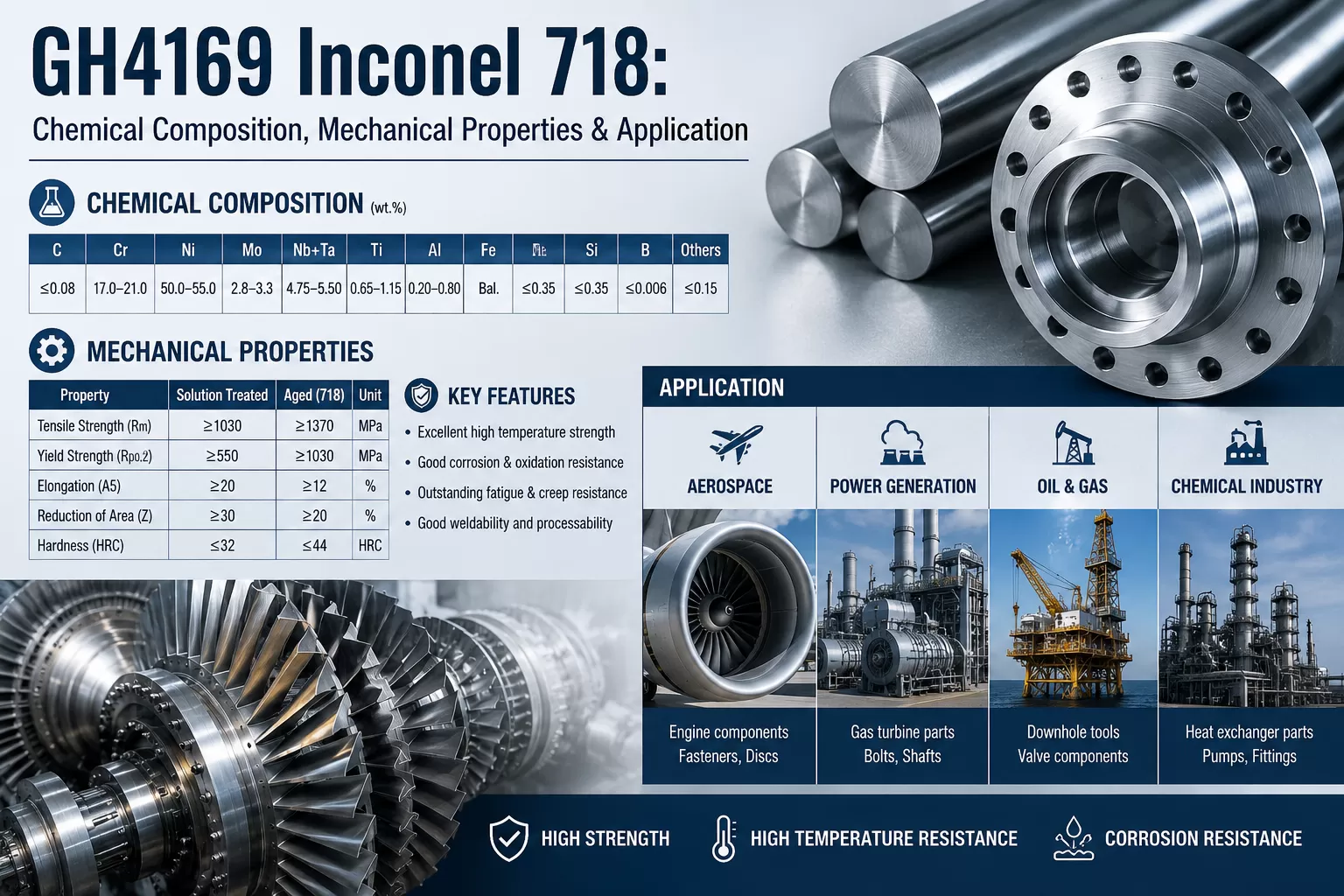
GH4169 is the Chinese national standard designation for the globally renowned Inconel 718 (UNS N07718, W.Nr. 2.4668) precipitation-hardening nickel-based superalloy. This alloy delivers exceptional comprehensive performance across a wide temperature range from -253°C to 700°C, with its yield strength below 650°C ranking first among all wrought superalloys. It exhibits outstanding fatigue resistance, radiation tolerance, oxidation resistance, corrosion resistance, and excellent weldability. GH4169/Inconel 718 is widely used in aerospace, nuclear energy, petroleum industries, and extrusion tooling for manufacturing complex-shaped components.
1. Chemical Composition of GH4169 (Inconel 718 / UNS N07718)
GH4169 and Inconel 718 share nearly identical chemical compositions, with nickel content around 50–55%, chromium 17–21%, and niobium 4.75–5.5%. The alloy is strengthened by γ′ (Ni₃(Al,Ti)) and γ″ (Ni₃Nb) precipitates formed during aging treatments. Below is the complete chemical composition range for GH4169 (mass fraction %):
| Element | Min (%) | Max (%) |
|---|---|---|
| Nickel (Ni) | 50.0 | 55.0 |
| Chromium (Cr) | 17.0 | 21.0 |
| Iron (Fe) | Balance | Balance |
| Molybdenum (Mo) | 2.8 | 3.3 |
| Niobium (Nb) | 4.75 | 5.5 |
| Titanium (Ti) | 0.65 | 1.15 |
| Aluminum (Al) | 0.2 | 0.8 |
| Carbon (C) | — | 0.08 |
| Silicon (Si) | — | 0.35 |
| Manganese (Mn) | — | 0.35 |
| Phosphorus (P) | — | 0.015 |
| Sulfur (S) | — | 0.015 |
| Copper (Cu) | — | 0.30 |
| Cobalt (Co) | — | 1.00 |
| Boron (B) | — | 0.006 |
| Magnesium (Mg) | — | 0.01 |
2. Mechanical Properties of GH4169 (Inconel 718)
GH4169/Inconel 718 exhibits outstanding mechanical performance across a broad temperature spectrum from cryogenic to 700°C. The following tables summarize the instantaneous tensile properties at various test temperatures:
2.1 Instantaneous Tensile Properties – Room Temperature
| Diameter (mm) | Test Temp. | Tensile Strength (MPa) | Yield Strength (MPa) | Elongation (%) | Reduction of Area (%) | Hardness (HBW) | Impact KV₂ (J) |
|---|---|---|---|---|---|---|---|
| 16–115 | Room Temp | ≥1275 | ≥1035 | ≥12 | ≥15 | ≥331 | ≥32 |
| 16–115 | Room Temp | ≥1275 | ≥1030 | ≥12 | ≥15 | ≥331 | ≥39 |
| — | Room Temp | ≥1225 | — | ≥15 | ≥30 | 341–477 | ≥39 |
| — | Room Temp | ≥1225 | — | ≥15 | ≥30 | 341–477 | ≥39 |
2.2 Instantaneous Tensile Properties – Elevated & Cryogenic Temperatures
| Diameter (mm) | Test Temp. | Tensile Strength (MPa) | Yield Strength (MPa) | Elongation (%) | Reduction of Area (%) |
|---|---|---|---|---|---|
| 16–115 | 650°C | ≥1000 | ≥860 | ≥12 | ≥15 |
| 16–115 | -196°C | ≥1470 | — | ≥12 | ≥20 |
| — | 800°C | ≥540 | — | ≥15 | ≥25 |
| — | 600°C | ≥1080 | — | ≥12 | ≥20 |
| — | 400°C | ≥1130 | — | ≥12 | ≥20 |
| — | -196°C | ≥1470 | — | ≥12 | ≥20 |
2.3 Stress-Rupture Properties
| Diameter (mm) | Test Temp. | Stress (MPa) | Life (hours) |
|---|---|---|---|
| 16–115 | 650°C | 690 | ≥25 |
| — | 800°C | 390 | ≥30 |
| — | 600°C | 880 | ≥50 |
Note: Values shown are minimum requirements per GB/T and ASTM standards. Actual properties may vary by heat treatment and product form. Typical room-temperature tensile strength for Inconel 718 can reach 1375 MPa with yield strength of 1100 MPa.
3. Microstructure & Strengthening Mechanism
GH4169/Inconel 718 has an austenitic structure. After precipitation hardening, the γ″ phase (Ni₃Nb) forms, imparting excellent mechanical properties. During heat treatment, the δ phase precipitates at grain boundaries, contributing to optimal plasticity. The alloy is strengthened through a combination of solid-solution strengthening and precipitation hardening via γ′ and γ″ phases.
4. Industrial Applications of GH4169 / Inconel 718
GH4169/Inconel 718 is one of the most widely used nickel-based superalloys across multiple high-tech industries:
- Aerospace & Aviation: Turbine disks, blades, shafts, compressor disks, casings, rings, fasteners, elastic components, gas conduits, and rocket engine components.
- Nuclear Energy: Elastic components, grid structures, and reactor internal components requiring radiation resistance.
- Petroleum & Chemical: Corrosion-resistant equipment, downhole tools, subsea components, and extrusion dies.
- Power Generation: Gas turbine hot-section components, steam turbine blades, and nozzles.
5. Processing & Heat Treatment Parameters
5.1 Machining Characteristics
| Challenge | Description | Recommended Practice |
|---|---|---|
| Thermal Conductivity | Extremely poor, leading to high cutting temperatures | Use carbide tooling; apply adequate coolant |
| Cutting Force | High alloying content results in high cutting forces | Optimize cutting parameters; use rigid setups |
| Work Hardening | Severe work-hardening tendency during machining | Maintain sharp cutting edges; avoid dwell |
| Tool Wear | Hard particles in the alloy cause rapid wear | Use premium carbide or ceramic inserts; centerless grinding for tight tolerances |
5.2 Hot Heading (Forging) Parameters
| Parameter | Value / Requirement |
|---|---|
| Heading (forming) temperature | 1040 – 1090°C |
| Final heading (finish) temperature | 930 – 950°C |
| Grain size (standard strength) | Grade 4 – 6 |
| Grain size (high strength) | Grade 8 |
5.3 Heat Treatment Schedules & Achievable Properties
| Condition | Heat Treatment Parameters | Achievable Performance |
|---|---|---|
| Solution + Aged | Solution: 950 – 980°C; Double Aging: 720°C × 8h + 620°C × 8h |
Tensile Strength ≤ 1700 MPa; Hardness ≤ 450 HBW |
| Solution + Cold Work + Aged | Cold work prior to aging; subsequent aging schedule same as above | Enhanced yield strength with moderate ductility |
Different heat treatment schedules can be employed to control grain size, δ phase morphology, distribution, and quantity, thereby achieving different levels of mechanical properties.
6. Selection Recommendations
GH4169/Inconel 718 is recommended for applications meeting the following criteria:
| Selection Parameter | Requirement / Range |
|---|---|
| Tensile Strength (max) | Up to 1700 MPa |
| Shear Strength (min) | ≥ 780 MPa |
| Service Temperature Range | -200°C to +700°C |
| Environmental Resistance | Oxidation and corrosion resistance required |
| Typical Product Forms | Bolts, screws, pins, washers, high-lock fasteners, and special-purpose parts |
Note: GH4169 follows Chinese GB/T and HB standards, while Inconel 718 follows ASTM and AMS international standards. GH4169 is typically more cost-effective with shorter supply lead times for domestic Chinese projects, whereas Inconel 718 is preferred for international programs and high-precision applications.
7. Global Grade Equivalents
| Country / Region | Standard | Grade Designation |
|---|---|---|
| China | GB/T | GH4169 (formerly GH169) |
| USA | UNS | N07718 |
| USA | ASTM / AMS | Inconel 718 / Alloy 718 |
| Germany / Europe | EN / DIN | W.Nr. 2.4668 / NiCr19Fe19Nb5Mo3 |
| France | NF | NC19FeNb |
| UK | BS | NA 51 |
8. Conclusion
GH4169 (Inconel 718 / UNS N07718) is a premier precipitation-hardening nickel-based superalloy that delivers unmatched comprehensive performance from cryogenic to high-temperature environments. With its exceptional strength below 650°C, outstanding corrosion and oxidation resistance, and excellent fabricability, this alloy remains the material of choice for critical aerospace, nuclear, and petroleum applications. Understanding its chemical composition, mechanical properties, and processing parameters is essential for engineers and procurement professionals seeking reliable, high-performance materials for demanding service conditions.
Key takeaway: GH4169 and Inconel 718 are essentially the same alloy under different national standards – choose GH4169 for domestic Chinese projects and Inconel 718 for international applications, always verifying compliance with your specific project requirements and standards.