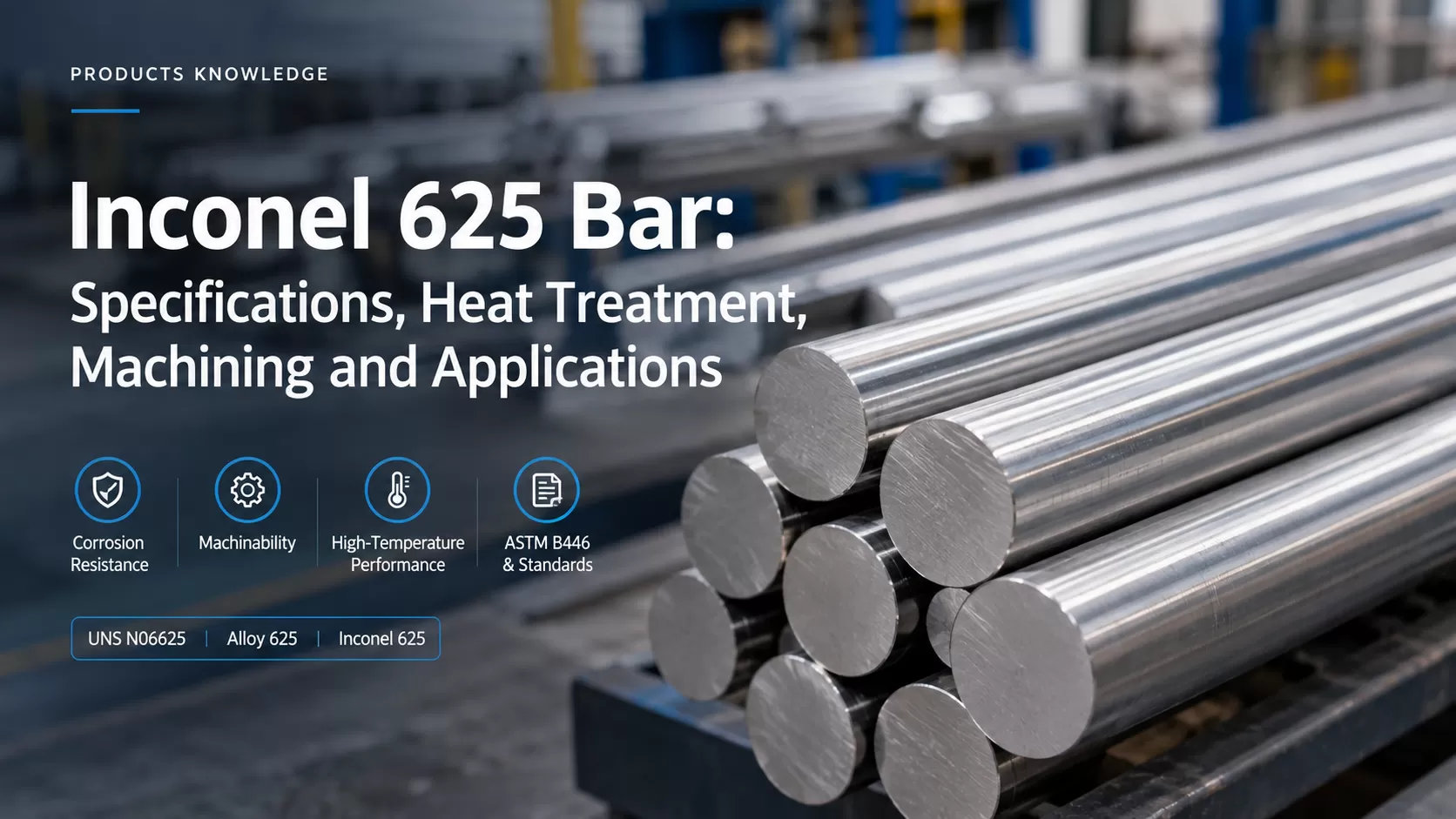
Alloy 625 (UNS N06625 / 2.4856): A Comprehensive Technical Review of the Solid-Solution Strengthened Nickel-Based Superalloy
Abstract · Metallurgical Design · Mechanical & Corrosion Properties · Heat Treatment · Welding · Applications
Abstract
Alloy 625 (UNS N06625, DIN 2.4856, GH3625) stands as one of the most versatile nickel-based superalloys in modern engineering, uniquely balancing high-temperature strength, oxidation resistance, and exceptional corrosion resistance across multiple aggressive media. This article provides a systematic examination of its metallurgical design, mechanical properties, corrosion behavior, thermal processing requirements, and application boundaries, serving as a technical reference for engineers engaged in material selection for demanding service environments.
1. Metallurgical Design and Strengthening Mechanism
1.1 Matrix and Alloying Elements
Alloy 625 is built upon a nickel matrix with a minimum nickel content of 58%, which ensures austenitic stability, suppresses chloride-induced stress corrosion cracking, and preserves low-temperature impact toughness. The alloying strategy employs a synergistic combination of four key elements:
- Chromium (20–23%): Forms a dense chromium oxide passive film that provides both general corrosion resistance and high-temperature oxidation protection up to approximately 980°C.
- Molybdenum (8–10%): The primary element for pitting and crevice corrosion resistance in halide-containing media. Its large atomic radius creates substantial lattice distortion, significantly impeding dislocation motion and contributing to solid-solution strengthening.
- Niobium + Tantalum (3.15–4.15%): The defining element of Alloy 625. Niobium preferentially combines with carbon to form stable NbC carbides, preventing chromium carbide precipitation at grain boundaries—a critical mechanism that eliminates sensitization and intergranular corrosion risk after welding. Niobium also works synergistically with molybdenum to enhance solid-solution strengthening.
- Iron (≤5%): Tightly controlled to minimize the formation of detrimental intermetallic phases.
This composition yields a Pitting Resistance Equivalent Number (PREN) of approximately 45, surpassing most super-austenitic stainless steels and approaching that of high-end Hastelloy grades.
1.2 Solid-Solution Strengthening vs. Precipitation Hardening
A critical distinction: Alloy 625 is solid-solution strengthened, not precipitation-hardened. Unlike alloys such as Inconel 718 (N07718) or 725 (N07725), which derive strength from gamma-prime (γ′) or gamma-double-prime (γ″) precipitates through aging treatments, Alloy 625 achieves its mechanical properties through molybdenum and niobium atoms dissolved in the austenitic lattice. This fundamental difference means:
- Strength cannot be increased through age-hardening heat treatments.
- Cold working is the only practical method for strength enhancement, though it reduces ductility.
- The alloy avoids the over-aging embrittlement risks associated with Al-Ti-based γ′ phases in long-term service.
2. Mechanical Properties Across Temperature Extremes
2.1 Room-Temperature Properties
In the solution-annealed condition, Alloy 625 exhibits:
- Tensile strength: ≥690 MPa (100 ksi)
- Yield strength (0.2% offset): ≥275 MPa (40 ksi)
- Elongation: ≥30%
- Brinell hardness: typically ≤240 HB
The combination of high strength and exceptional ductility facilitates cold forming operations such as rolling and bending.
2.2 Cryogenic Performance
At −196°C, Alloy 625 maintains high impact toughness without低温 brittle fracture, making it suitable for cryogenic equipment and liquefied natural gas (LNG) applications.
2.3 High-Temperature Capability
At 980°C, the alloy retains appreciable tensile strength and fatigue resistance. However, service temperature boundaries must be carefully distinguished:
- Corrosion-dominated applications: ≤650°C for长期 service
- Oxidation-dominated applications: Up to 900°C for extended periods
2.4 Magnetic Properties
The alloy is fundamentally non-magnetic, with only negligible magnetism even after cold working.
3. Corrosion Resistance: A Multi-Environment Shield
Alloy 625's corrosion resistance is its most celebrated attribute, delivering stable performance across diverse aggressive media.
3.1 Pitting and Crevice Corrosion Resistance
In seawater, brine, and high-chloride process streams, Alloy 625 demonstrates outstanding resistance to localized corrosion, including in stagnant seawater crevice conditions—a key reason for its extensive use in offshore platforms.
3.2 Chloride Stress Corrosion Cracking (SCC) Immunity
Unlike conventional austenitic stainless steels that frequently suffer chloride-induced SCC failures, Alloy 625 components rarely experience such failures, significantly enhancing the safety margin of pressure vessels and heat exchangers.
3.3 Broad Uniform Corrosion Resistance
The alloy performs reliably in nitric acid, phosphoric acid, various organic acids, and certain concentrations of dilute sulfuric acid, as well as in high-temperature strong alkali solutions. In sour gas environments containing hydrogen sulfide and carbon dioxide, it likewise demonstrates dependable service performance.
3.4 Recognized Limitations
Alloy 625 is not universally applicable:
- Concentrated hydrochloric acid and strong reducing acids: Corrosion rates rise significantly; C276 (higher molybdenum content) is the preferred choice.
- High-temperature sulfur-bearing atmospheres: Sulfidation corrosion occurs; design evaluation is essential.
4. Heat Treatment and Thermal Processing
- Solution Annealing (1080–1160°C): Standard treatment for high-temperature and corrosion service. Sufficient soaking time ensures complete dissolution of molybdenum and niobium into the austenitic matrix, followed by air or water quenching to obtain a homogeneous single-phase austenitic structure.
- Softening Annealing (950–1050°C): Recommended for components requiring extensive cold forming.
- Hot Working (950–1150°C): Post-hot-working annealing is mandatory to eliminate deformation-induced microstructures.
- Stress-Relief Annealing (600–810°C): Applied to components with significant residual stress that will serve in corrosive environments.
- Critical Warning: 550–850°C Avoidance — Prolonged exposure in this range promotes precipitation of detrimental intermetallic phases, compromising both toughness and corrosion resistance.
5. Welding and Fabrication
Alloy 625 exhibits mature weldability across multiple processes including TIG and SMAW:
- Preheating: Generally not required
- Joint preparation: Must be meticulously cleaned of oil and scale to prevent hot cracking from sulfur/lead contamination
- Filler metal: ERNiCrMo-3 (matching composition); never substitute with stainless steel fillers
- Heat input control: Moderate levels with controlled interpass temperatures to minimize harmful phase precipitation in the heat-affected zone
Thanks to niobium's stabilizing effect, the as-welded condition already provides good intergranular corrosion resistance; post-weld solution treatment is unnecessary for most applications, reserved only for thick-wall components or extremely aggressive service.
5.1 Machining Considerations
The alloy's strong work-hardening tendency and poor thermal conductivity demand:
- Low cutting speeds
- Ample coolant supply
- Continuous tool engagement to avoid work-hardened layers
- Intermediate annealing for heavily cold-worked parts
6. Industrial Applications
Alloy 625 spans multiple demanding sectors:
- Offshore oil & gas: Platform piping, subsea equipment, downhole tools, desalination heat exchangers
- Chemical processing: Corrosion reactors, heat exchangers, evaporators, high-pressure piping, valves, flanges
- Aerospace: Engine ducts, combustion chamber components, structural parts
- Nuclear power: Station piping, fasteners, structural supports
- Flue gas desulfurization (FGD): Absorber internals, spray headers
- Geothermal and waste-to-energy: Equipment exposed to mixed corrosive environments
7. Engineering Selection Caveats
Despite its versatility, prudent material selection demands attention to:
- Cost awareness: The high noble metal content (Ni, Mo, Nb) makes Alloy 625 expensive; avoid over-specification for mild corrosion duties
- Quality verification: Verify Mo and Nb content through mill certificates and on-site PMI (positive material identification); non-compliant materials compromise performance
- No direct substitution: Do not interchange with C276, 718, or 725 without thorough service condition evaluation—each has distinct composition, strengthening mechanism, and applicable media
- Temperature and environment boundaries: Respect limitations in strong reducing acids and high-temperature sulfur atmospheres
Conclusion
DIN 2.4856 (Alloy 625 / UNS N06625 / GH3625) represents a rare engineering achievement: a solid-solution strengthened nickel alloy that harmonizes high-temperature strength, oxidation resistance, acid resistance, and chloride pitting resistance within a single material system. With mature weldability and a service temperature range spanning from cryogenic to nearly 1000°C, it remains an indispensable solution for equipment failures that conventional steels cannot address. As offshore development, nuclear power, fine chemicals, and advanced manufacturing continue to evolve, Alloy 625 will undoubtedly expand its role in extreme service conditions.
Technical Reference · Alloy 625 Material Review




 en
en
 ko
ko
 ru
ru
 es
es
 ar
ar
 hi
hi