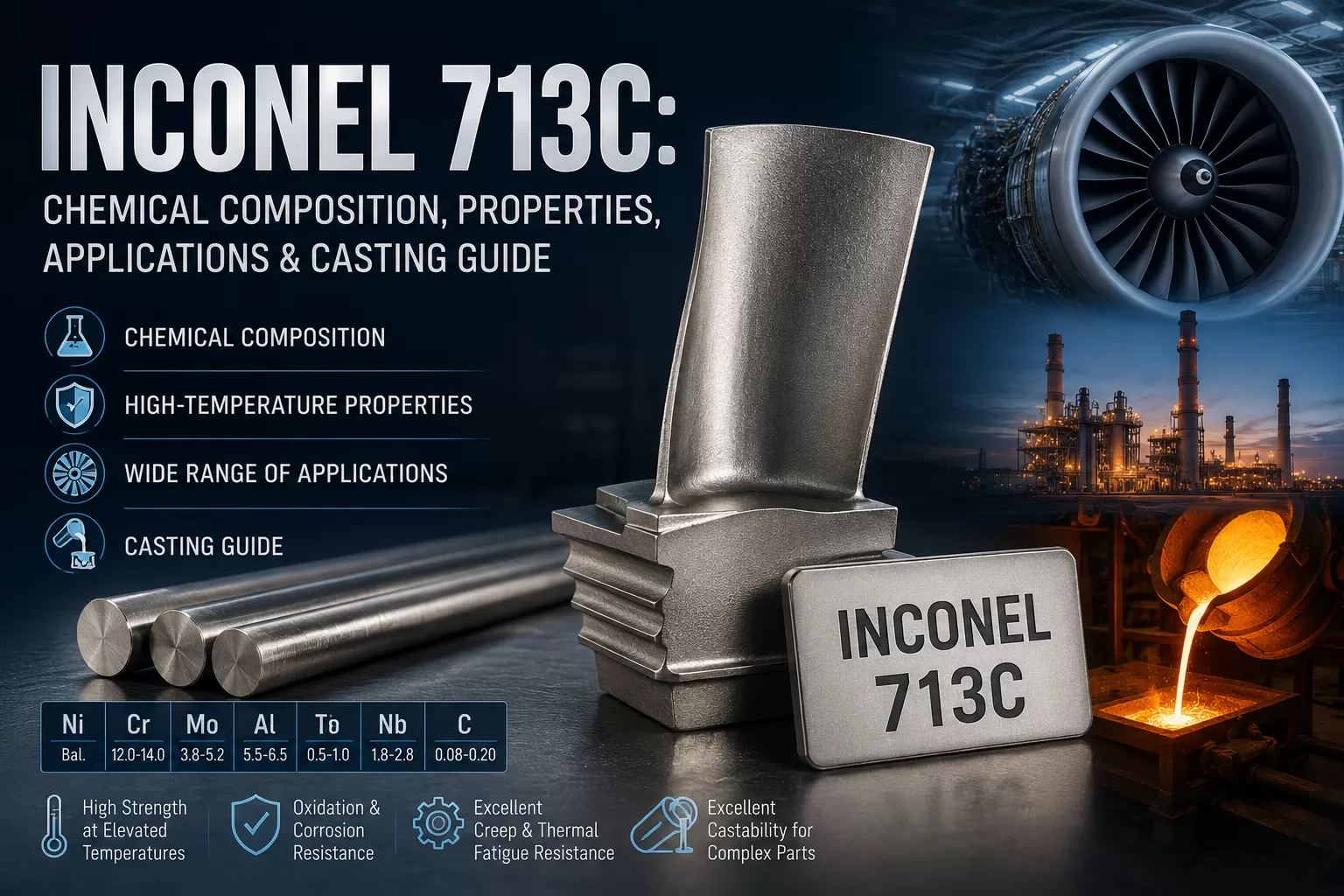
Inconel 713C is a precipitation-hardenable nickel-chromium base cast superalloy developed for high-temperature applications where strength, creep resistance, oxidation resistance, and thermal stability are critical. Unlike many wrought nickel alloys, Alloy 713C is primarily known as a cast nickel-based superalloy, making it particularly suitable for complex turbine components and other near-net-shape parts.
This guide explains the Inconel 713C chemical composition, mechanical properties, high-temperature performance, microstructure, casting characteristics, applications, and material selection considerations to help engineers determine whether 713C is suitable for a specific high-temperature component.
Inconel 713C, commonly referred to as Alloy 713C or IN 713C, is a nickel-chromium-based precipitation-hardenable superalloy designed primarily for high-temperature cast components. It is also designated as UNS N07713 and conforms to AMS 5391. The domestic Chinese equivalent is K418 (also known as K18), a cobalt-free equiaxed grain cast superalloy.
Its performance comes from a combination of a nickel-based matrix, chromium for oxidation resistance, molybdenum for solid-solution strengthening, and aluminum and titanium for the formation of the strengthening γ′ (gamma-prime) phase.
According to Nickel Institute technical data, Alloy 713C possesses excellent strength properties up to approximately 1800°F (980°C), along with good castability, remarkable resistance to oxidation and thermal fatigue, and outstanding structural stability.
The most important characteristic of 713C is therefore not simply its nominal strength, but its ability to maintain useful mechanical properties when exposed to high temperature, cyclic thermal loading, oxidation, and sustained mechanical stress.
The chemical composition of Inconel 713C is carefully balanced to provide high-temperature strength while maintaining suitable casting characteristics. The table below shows the nominal composition and the range specified by AMS 5391.
| Element | Nominal (wt.%) | Range (AMS 5391) (wt.%) | Primary Function |
|---|---|---|---|
| Nickel (Ni) | Balance | ~74–79 | Matrix |
| Chromium (Cr) | 12.50 | 12.00–14.00 | Oxidation & corrosion resistance |
| Molybdenum (Mo) | 4.20 | 3.80–5.20 | Solid-solution strengthening |
| Columbium + Tantalum (Nb+Ta) | 2.20 | 1.80–2.80 | Strengthening & carbide formation |
| Aluminum (Al) | 6.10 | 5.50–6.50 | γ′ precipitation strengthening |
| Titanium (Ti) | 0.80 | 0.50–1.00 | γ′ precipitation strengthening |
| Carbon (C) | 0.12 | 0.08–0.20 | Carbide formation |
| Boron (B) | 0.012 | 0.005–0.015 | Grain-boundary strengthening |
| Zirconium (Zr) | 0.10 | 0.05–0.15 | Grain-boundary strengthening |
| Iron (Fe) | lapt | 2.50 max | Controlled residual |
| Silicon (Si) | lapt | 0.50 max | — |
| Manganese (Mn) | lapt | 0.25 max | — |
Aluminum and titanium are particularly important because they promote the formation of γ′ precipitates (Ni3(Al,Ti)), which are a major source of high-temperature strength in nickel-based superalloys. The γ′ phase provides precipitation strengthening and helps the alloy resist deformation at elevated temperatures.
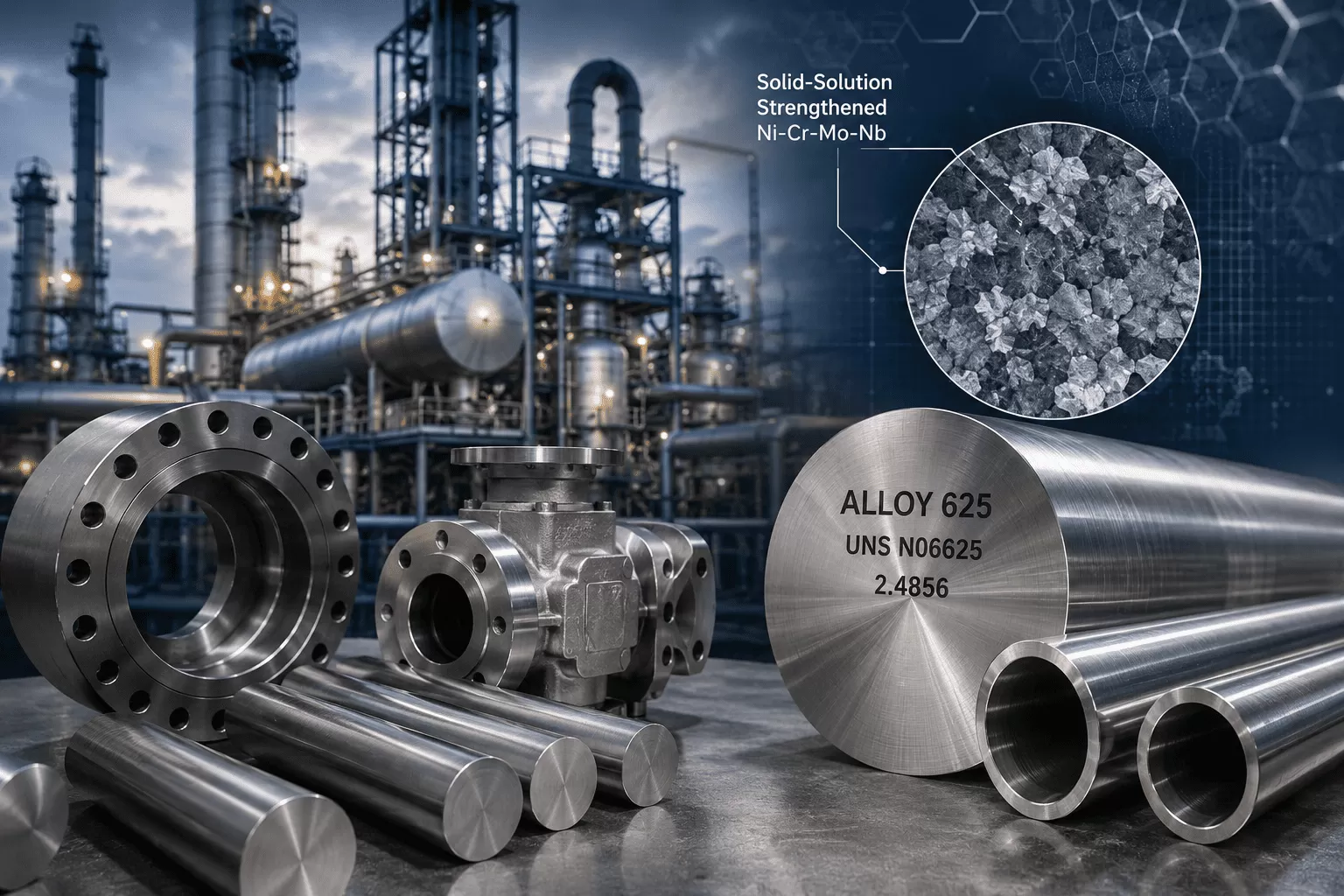
This microstructural design is one of the fundamental reasons why 713C performs differently from solid-solution-strengthened alloys such as Inconel 625.
The high-temperature performance of Inconel 713C is closely related to its microstructure. The alloy generally consists of a γ nickel-based matrix, γ′ precipitates, carbides, and eutectic constituents.
The strengthening mechanism can be understood through several complementary effects:
Aluminum and titanium form nickel-based γ′ precipitates (Ni3(Al,Ti)). These particles impede dislocation movement and provide significant strengthening at elevated temperatures. The γ′ phase volume fraction can exceed 50%.
Elements such as molybdenum contribute to solid-solution strengthening of the nickel matrix.
Carbon combines with carbide-forming elements (Nb, Ti, Cr) to produce stable carbide phases (MC, M23C6) that contribute to grain-boundary stability and high-temperature strength.
Controlled additions of boron and zirconium improve grain-boundary characteristics and contribute to high-temperature structural stability.
The combination of these mechanisms gives Inconel 713C its characteristic balance of strength, creep resistance, thermal-fatigue resistance, and structural stability.
The actual properties of Alloy 713C depend on factors such as casting method, heat treatment, test temperature, specimen orientation, and applicable specification. Engineers should use certified test data for final design calculations.
| Property | Value | Source |
|---|---|---|
| Density | 7.913 g/cm³ (0.286 lb/in³) | Nickel Institute |
| Melting Range | 1260–1288°C (2300–2350°F) | Nickel Institute |
| Thermal Conductivity (20°C) | ~11–13 W/(m·K) | Various sources |
| Specific Heat Capacity (RT) | ~460 J/(kg·K) |
| Property | Minimum Requirement |
|---|---|
| 0.2% Yield Strength | 100,000 psi (minimum) |
| Tensile Strength | 110,000 psi (minimum) |
| Elongation (% in 4D) | 3% (minimum) |
| Hardness (HRC) | 30–42 |
Source: AMS 5391 as referenced by multiple technical sources.
In SI units, representative room-temperature values are approximately:
Because published values vary between specifications and processing conditions, these figures should be treated as reference values rather than universal design values.
High-temperature performance is the primary reason engineers select Inconel 713C.
At elevated temperatures, components used in turbines and combustion systems are subjected to simultaneous mechanical and environmental stresses, including sustained tensile stress, creep deformation, thermal cycling, oxidation, thermal fatigue, and hot-gas exposure.
Inconel 713C was specifically developed to address these conditions. The alloy retains useful strength properties up to approximately 1800°F (980°C).
Stress-Rupture Performance: AMS 5391 specifies a stress-rupture requirement at 1800°F (982°C) of 22,000 psi for at least 30 minutes.
In the 800–1000°C range, the alloy exhibits excellent creep resistance. For example, at 870°C under 276 MPa stress, the rupture life typically exceeds 100 hours.
However, this does not mean that every 713C component can continuously operate at 980°C. Actual allowable service temperature depends on stress level, component geometry, atmosphere, casting quality, heat treatment, cooling conditions, and design life.
Inconel 713C combines high-temperature strength with useful oxidation resistance.
Chromium (12–14%) contributes to the formation of protective chromium-rich oxide scales (Cr2O3), while the relatively high aluminum content (5.5–6.5%) also supports the formation of aluminum-rich protective oxides.
This combination is particularly important in gas turbine environments where components may be exposed to hot combustion gases, high-temperature air, thermal cycling, fuel contaminants, and deposited salts.
Research has shown that IN 713C exhibits good oxidation resistance up to 1000°C. In one comparative study, IN 713C demonstrated better oxidation resistance than Hastelloy X.
However, Inconel 713C should not automatically be treated as a universal corrosion-resistant alloy. In aggressive chemical environments, particularly strongly reducing or acidic environments, another nickel alloy may provide a more appropriate balance of corrosion resistance and mechanical performance. For turbine applications involving severe hot corrosion, protective coatings and environmental controls may also be required.
One of the most important differences between Inconel 713C and many commonly used wrought nickel alloys is its strong association with casting technology.
713C was designed to provide high-temperature performance in components with complex geometries that would be difficult or uneconomical to manufacture through conventional wrought processing.
Its casting advantages include:
Vacuum melting and vacuum casting can be used to achieve more consistent high-temperature properties. Nickel Institute documentation specifically notes that with the advent of improved vacuum technology, an increased level of high-temperature properties can be consistently attained by vacuum melting the master alloy and remelting and casting it under vacuum.
Casting quality is therefore a critical part of 713C component performance. Factors such as porosity, inclusions, grain structure, segregation, and heat-treatment condition can significantly affect fatigue and creep performance.
For critical aerospace or power-generation components, material traceability and quality documentation are as important as the nominal alloy designation itself.
The combination of castability and high-temperature strength makes Inconel 713C particularly suitable for turbine and combustion-related components.
Typical applications include:
The ability to produce complex cast geometries is especially valuable for turbine components containing internal passages or intricate aerodynamic profiles.
Inconel 713C can also be considered for:
The alloy's combination of high-temperature strength, oxidation resistance, and casting capability makes it suitable for selected turbocharger components operating under severe thermal and mechanical loading. A novel vacuum centrifugal investment casting route has been developed specifically for thin-walled IN713C turbocharger turbines.
Depending on the specific operating conditions, 713C may also be considered for selected components in power-generation equipment, industrial combustion systems, high-temperature rotating machinery, and thermal processing equipment.
The correct alloy should always be selected based on actual temperature, stress, environment, fatigue requirements, and expected service life. Contact our engineers for tailored material recommendations.
Not every nickel-based superalloy is designed for the same manufacturing process or service environment.
| Material | Main Strength | Typical Manufacturing Focus | Typical Application |
|---|---|---|---|
| Inconel 713C | High-temperature cast strength | Casting | Turbine blades, vanes, turbocharger components |
| Inconel 718 | High strength & good fabricability | Wrought / forged | Aerospace structures, shafts, discs |
| Inconel 625 | Corrosion resistance & weldability | Wrought | Chemical, marine, oil & gas |
| Inconel 738 | High-temperature creep strength | Casting | Turbine blades and vanes |
The key point is that 713C should not be selected simply because it has a high tensile strength.
If the component requires complex cast geometry and high-temperature creep resistance, 713C can be highly attractive. If the component requires extensive forging, welding, or superior corrosion resistance, another nickel alloy may be more appropriate.
Inconel 718, for example, is typically preferred for structurally loaded parts that require high strength, good toughness, and reliable post-heat-treatment performance, while Inconel 713C is considered when the thermal environment becomes more severe.
Before specifying Inconel 713C, engineers should evaluate several factors.
Determine both the normal operating temperature and peak temperature. 713C is suitable for sustained service up to approximately 900°C, with capability to 980°C under specific conditions.
Consider tensile stress, centrifugal stress, creep, fatigue, thermal fatigue, and stress rupture.
If the component has complex geometry, investment casting may offer significant advantages. 713C is not suitable for wrought processing (forging, rolling).
Evaluate exposure to oxidizing gases, hot corrosion, sulfur-containing fuel, salts, combustion products, and chemical media.
The final material should be purchased according to the appropriate specification, including chemical composition, mechanical properties, casting condition, heat treatment, testing, inspection, and traceability requirements. AMS 5391 is the primary specification for Alloy 713C.
This is particularly important for aerospace and power-generation applications where material certification and quality assurance are essential.
Yes. Inconel 713C is a nickel-based, nickel-chromium precipitation-hardenable superalloy developed primarily for high-temperature cast applications.
713C is primarily recognized as a cast nickel-based superalloy and is not forgeable (不可锻造). It is particularly suited for investment-cast high-temperature components.
Typical applications include gas turbine blades, turbine vanes, turbine wheels, turbocharger components, and other high-temperature cast components.
Its high-temperature strength is mainly associated with γ′ precipitation strengthening (Ni3(Al,Ti)), supported by solid-solution strengthening (Mo) and carbide-related microstructural strengthening.
Alloy 713C retains useful high-temperature properties to approximately 1800°F (980°C) under specific test conditions. The allowable continuous service temperature for a component must be determined from the actual stress, environment, geometry, cooling conditions, and design requirements.
713C has good oxidation resistance and useful resistance to hot-corrosion environments, but it is not a universal corrosion-resistant alloy. Material selection should consider the specific chemical environment and operating temperature.
The domestic Chinese equivalent is K418 (also designated K18), a cobalt-free equiaxed grain cast superalloy that meets GB/T 14992 and HB 5162-1988.
The primary specification is AMS 5391. The alloy is also designated as UNS N07713.
Inconel 713C is a specialized nickel-based superalloy designed around one central engineering requirement: maintaining strength and structural stability in demanding high-temperature environments while providing the castability needed for complex components.
Its performance comes from the interaction of its nickel-based matrix, chromium, molybdenum, aluminum, titanium, niobium, carbon, and controlled grain-boundary elements. In particular, γ′ precipitation strengthening gives the alloy its characteristic high-temperature strength, while chromium and aluminum contribute to oxidation resistance.
For engineers working with turbine blades, vanes, turbocharger components, and other high-temperature castings, the most important consideration is not simply whether 713C has high strength. The real question is whether its casting capability, creep resistance, thermal-fatigue performance, oxidation resistance, and temperature capability match the requirements of the component.
That is why Inconel 713C remains a valuable option for demanding high-temperature casting applications—and why the correct material specification, casting process, heat treatment, inspection, and traceability should be considered together when developing a finished component.
2026-09-04 16:07:31
2026-09-03 16:46:28
2026-08-31 00:00:00



25th floor, C3 Building, Wanda Plaza, Kaifu District, Changsha, Hunan Province, China
 en
en
 ko
ko
 ru
ru
 es
es
 ar
ar
 hi
hi