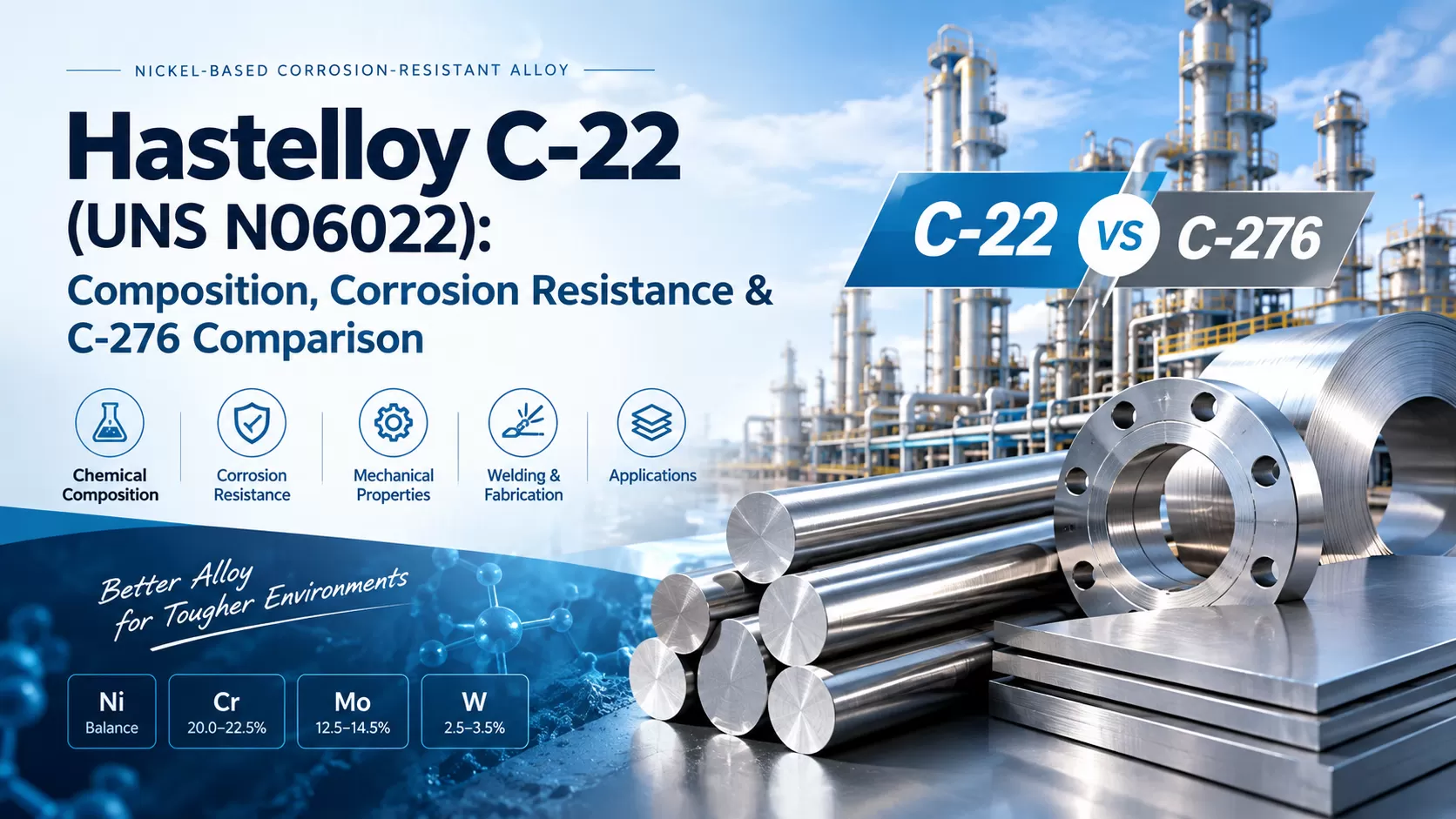
Nickel-based alloys represent one of the most critical material classes in modern industry, combining exceptional high-temperature strength with outstanding corrosion resistance. As a ferromagnetic metallic element, nickel possesses excellent properties including corrosion resistance, high-temperature endurance, oxidation resistance, and superior ductility. These characteristics make it indispensable across metallurgy, chemical engineering, aerospace, and beyond—serving as a key raw material for stainless steel, superalloys, and power batteries.
Global nickel resources are concentrated primarily in Indonesia, Australia, Brazil, and Russia. China, however, accounts for less than 3% of global nickel reserves, rendering it a "nickel-poor" nation heavily dependent on imports for this strategic metal.
A nickel-based alloy is generally defined as any alloy with a nickel content exceeding 30 wt%, though most commercial products contain over 50 wt% nickel. Alongside iron-based and cobalt-based alloys, nickel-based alloys are classified as superalloys—materials specifically engineered for service at temperatures exceeding 540°C. Their exceptional mechanical strength and corrosion resistance at elevated temperatures make them the material of choice for specialized corrosive environments, high-temperature oxidation conditions, and applications demanding sustained mechanical integrity.
| Industry | Critical Property Requirements | Typical Applications |
|---|---|---|
| Aerospace | High-temperature mechanical strength | Aircraft engines, gas turbines, engine valves |
| Energy | Sulfidation and oxidation resistance | Furnace components, thermal barriers, heat treatment, oil & gas |
| Petrochemical | Corrosion resistance (acids, alkalis, chlorides) | Desalination plants, transmission pipelines |
| Electronics / General | Moderate corrosion/heat resistance | Battery casings, lead frames, monitor mesh |
The development of nickel-based alloys began in the late 1930s. The United Kingdom pioneered production in 1941 with Nimonic 75 (Ni-20Cr-0.4Ti). The addition of aluminum to enhance creep strength led to Nimonic 80 (Ni-20Cr-2.5Ti-1.3Al). The United States followed in the mid-1940s, Russia in the late 1940s, and China in the mid-1950s.
Two parallel paths have driven nickel-based alloy advancement: compositional refinement and manufacturing innovation. The advent of vacuum melting technology in the early 1950s enabled the production of alloys with high aluminum and titanium content, dramatically increasing both strength and service temperature. As turbine blade operating temperatures rose in the late 1950s, higher-strength alloys became increasingly difficult to deform—prompting the development of precision casting technologies and a new generation of cast superalloys. The 1960s brought further breakthroughs with directionally solidified and single-crystal superalloys, alongside powder metallurgy superalloys.
📈 The performance trajectory is remarkable: between the early 1940s and the late 1970s—a span of approximately 40 years—the service temperature of nickel-based alloys rose from 700°C to 1,100°C, an average annual increase of roughly 10°C. Today, modern alloys like MA6000 achieve tensile strength of 2,220 MPa and yield strength of 192 MPa at 1,100°C, with creep-rupture strength exceeding 1,000 hours under 137 MPa at the same temperature—making them viable for aircraft engine blades.
Nickel-based superalloys are the most widely used and highest-strength members of the superalloy family. Their defining features include:
Nickel maintains an austenitic, face-centered cubic (FCC) structure up to its melting point, providing significant freedom from ductile-to-brittle transitions and minimizing manufacturing complications. In the electrochemical series, nickel is more inert than iron but more active than copper—rendering it more corrosion-resistant than iron in reducing environments, though less so than copper. The addition of chromium enables oxidation resistance, allowing nickel-based alloys to perform effectively in both reducing and oxidizing environments.
Compared to stainless steels and other iron-based alloys, nickel-based alloys can accommodate a wider range of alloying elements in solid solution while maintaining metallurgical stability. Below is a summary of key alloying elements and their primary functions:
| Element | Primary Functions |
|---|---|
| Nickel (Ni) | Metallurgical stability, thermal stability, weldability, reducing acid resistance, caustic soda resistance, stress corrosion cracking resistance (especially in chlorides and caustic environments). |
| Chromium (Cr) | Oxidation resistance, high-temperature sulfidation resistance, pitting resistance, crevice corrosion resistance. |
| Molybdenum (Mo) | Reducing acid resistance, pitting/crevice corrosion resistance in chloride-containing aqueous solutions, high-temperature strength. |
| Iron (Fe) | High-temperature carburization resistance, cost reduction, thermal expansion control. |
| Copper (Cu) | Reducing acid resistance (especially sulfuric and hydrofluoric acids in non-aerated conditions), salt corrosion resistance; enhances resistance to hydrofluoric, phosphoric, and sulfuric acids in Ni-Cr-Mo-Fe alloys. |
| Aluminum (Al) | High-temperature oxidation resistance, age-hardening. |
| Titanium (Ti) | Carbide formation (reducing intergranular corrosion from chromium carbide precipitation during heat treatment), age-strengthening. |
| Niobium (Nb) | Carbide formation (reducing intergranular corrosion), pitting/crevice corrosion resistance, high-temperature strength. |
| Tungsten (W) | Reducing acid resistance, localized corrosion resistance, strength enhancement, weldability. |
| Nitrogen (N) | Metallurgical stability, pitting/crevice corrosion resistance, strength. |
| Cobalt (Co) | High-temperature strength enhancement, carburization resistance, sulfidation resistance. |
Many of these elements form single-phase solid solutions with nickel across broad compositional ranges, ensuring reliable corrosion resistance under diverse conditions. In the fully annealed state, these alloys exhibit excellent mechanical properties without harmful metallurgical transformations during manufacturing or hot working. Strengthening mechanisms include solid-solution hardening, carbide precipitation, precipitation (age) hardening, and dispersion strengthening.
As industries continue to push the boundaries of operating temperatures and corrosive environments—particularly in next-generation aerospace propulsion, advanced energy systems, and deep-sea resource extraction—nickel-based superalloys will remain indispensable. Ongoing research into compositional optimization and advanced manufacturing techniques promises to further extend the performance envelope of this remarkable class of materials.



25th floor, C3 Building, Wanda Plaza, Kaifu District, Changsha, Hunan Province, China
 en
en
 ko
ko
 ru
ru
 es
es
 ar
ar
 hi
hi