Focus: Material Composition · Pitting Mechanism · Grade Equivalents · Selection Logic
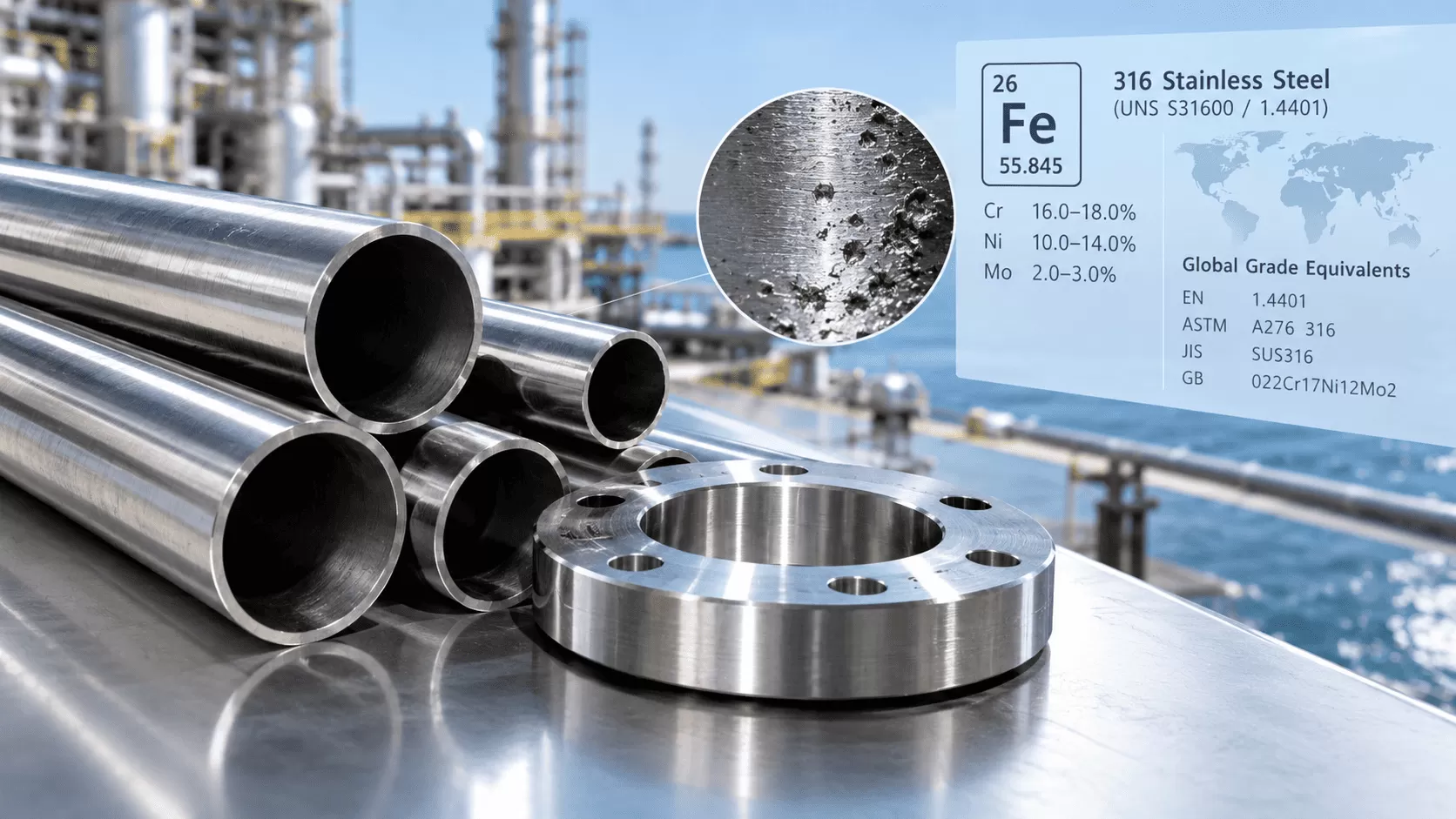
316 stainless steel (UNS S31600, DIN 1.4401, SUS316, GB 06Cr17Ni12Mo2) is the workhorse material for chemical processing and marine environments where chloride-induced pitting corrosion threatens equipment integrity. This article examines the metallurgical logic behind its molybdenum-bearing composition, the mechanism by which molybdenum enhances passive film stability in chloride-bearing media, the global grade designation system, and the critical distinctions between 316, 316L, 316Ti, and 304 that govern correct material selection. Engineers and procurement teams will find practical guidance on aligning material numbers across international standards and avoiding common specification errors.
On coastal equipment and marine structures, a characteristic corrosion pattern frequently emerges: surfaces remain bright, yet small pits erupt with rust spots that reappear after wiping and deepen progressively into the material. This pitting corrosion is not typically a case of the wrong material being purchased. Rather, chloride ions in the service medium are actively seeking weak points in the passive film.
The passive film on stainless steel is a thin, self-repairing chromium oxide layer. Chromium provides the film's fundamental stability. However, in chloride-bearing environments, the film becomes vulnerable to localized breakdown at weak points—inclusions, grain boundaries, or sites of mechanical damage. Once breakdown initiates, the pit grows autocatalytically, and the resulting corrosion can penetrate deeply while the surrounding surface remains visually intact.
The defining alloying addition in 316 stainless steel is molybdenum (2.00–3.00%). While chromium enables the passive film to form, molybdenum makes that film resistant to localized breakdown in chloride-containing media. The mechanism involves molybdenum's incorporation into the passive film as molybdate species, which:
Compared to molybdenum-free grades such as 304, 316 exhibits substantially improved resistance to both pitting corrosion and chloride-induced stress corrosion cracking in marine and chemical processing environments. This fundamental compositional difference explains why 316 has become the baseline material for chemical equipment and marine applications.
Table 1: Chemical Composition of 316 Stainless Steel
| Element | Content (wt%) |
|---|---|
| Chromium | 16.0–18.0 |
| Nickel | 10.0–14.0 |
| Molybdenum | 2.00–3.00 |
| Carbon | ≤0.08 |
| Silicon | ≤1.00 |
| Manganese | ≤2.00 |
| Phosphorus | ≤0.045 |
| Sulfur | ≤0.03 |
| Iron | Balance |
Table 2: Physical Properties
| Property | Value |
|---|---|
| Density | 7.98 g/cm³ |
| Melting Range | 1370–1400°C |
| Service Temperature Range | -196°C to 800°C |
| Magnetic State (solution-annealed) | Non-magnetic |
The non-magnetic characteristic in the solution-annealed condition is critical for field operations—many fittings, seals, and instrument installations assume non-magnetic materials. However, cold working increases magnetic permeability. Components subjected to significant cold deformation may exhibit measurable magnetism, a factor that must be considered in electromagnetic instrumentation and certain sealing applications.
A persistent challenge in international procurement is that the same material appears under different designations across standards systems:
Table 3: International Designations for 316 Stainless Steel
| System | Designation |
|---|---|
| AISI (US) | 316 |
| UNS (US) | S31600 |
| JIS (Japan) | SUS316 |
| DIN (Germany) | 1.4401 / 1.4436 |
| GB (China) | 06Cr17Ni12Mo2 |
| EN (Europe) | X5CrNiMo17-12-2 / X3CrNiMo17-13-3 |
| Other aliases | 0Cr17Ni12Mo2, S31608 |
These designations refer to the same material family, but they are not freely interchangeable in specification documents. Grades containing "L" (e.g., 316L) follow an ultra-low carbon route with a lower carbon ceiling, providing greater intergranular corrosion resistance after welding. Grades containing "Ti" (e.g., 316Ti) use titanium stabilization. Chinese unified numeric designations such as S31608 correspond to specific composition ranges defined in specific standards. The designation written on the mill certificate must match the standard against which verification is performed.
When European drawings specify 1.4401 while the purchase order states 316, alignment requires placing both the standard number and material number on a single document. The recommended practice is to specify:
With these four pieces of information, suppliers can organize production according to either system without ambiguity.
Table 4: Comparative Positioning of 316 and Related Grades
| Grade | Key Distinction | Best Suited For |
|---|---|---|
| 304 | No molybdenum | General corrosion, non-chloride environments |
| 316 | Mo-bearing, balanced performance | Chloride-bearing chemical and marine service |
| 316L | Ultra-low carbon | Welded structures requiring intergranular corrosion resistance |
| 316Ti | Titanium-stabilized | Elevated-temperature service with sensitization risk |
316 occupies a practical middle ground: corrosion resistance is adequate for most chloride-bearing service, strength does not depend on heat treatment, and both fabrication and welding are relatively straightforward.
Table 5: Typical Mechanical Properties of 316 (Annealed)
| Property | Value |
|---|---|
| Tensile Strength | ≥520 MPa |
| Yield Strength (0.2%) | ≥205 MPa |
| Elongation | ≥40% |
| Hardness | ≤HB 187 / ≤HRB 90 |
These values indicate that 316 is not a strength-driven material. Selection decisions for 316 are typically based on corrosion resistance and fabricability rather than mechanical load capacity.
For engineering material selection guidance covering a broader range of corrosion-resistant alloys, Ronsco's high-performance nickel alloys and special metals guide provides comparative data and application recommendations.
316 stainless steel addresses a specific and pervasive engineering problem—chloride-induced pitting corrosion—through the deliberate addition of molybdenum to the passive film-forming system. Its global designation system spans AISI, UNS, JIS, DIN, GB, and EN standards, each with distinct implications for composition control and delivery condition. Successful specification requires more than writing "316" on a purchase order: it demands alignment of grade designation, unified numbering, applicable standard, and delivery condition on a single specification document. When these elements are properly controlled, 316 delivers reliable, long-term performance in chemical processing, marine engineering, and coastal infrastructure—environments where molybdenum-free grades would rapidly fail.
2026-09-18 00:00:00
2026-09-04 16:07:31
2026-09-03 16:46:28



25th floor, C3 Building, Wanda Plaza, Kaifu District, Changsha, Hunan Province, China
 en
en
 ko
ko
 ru
ru
 es
es
 ar
ar
 hi
hi